
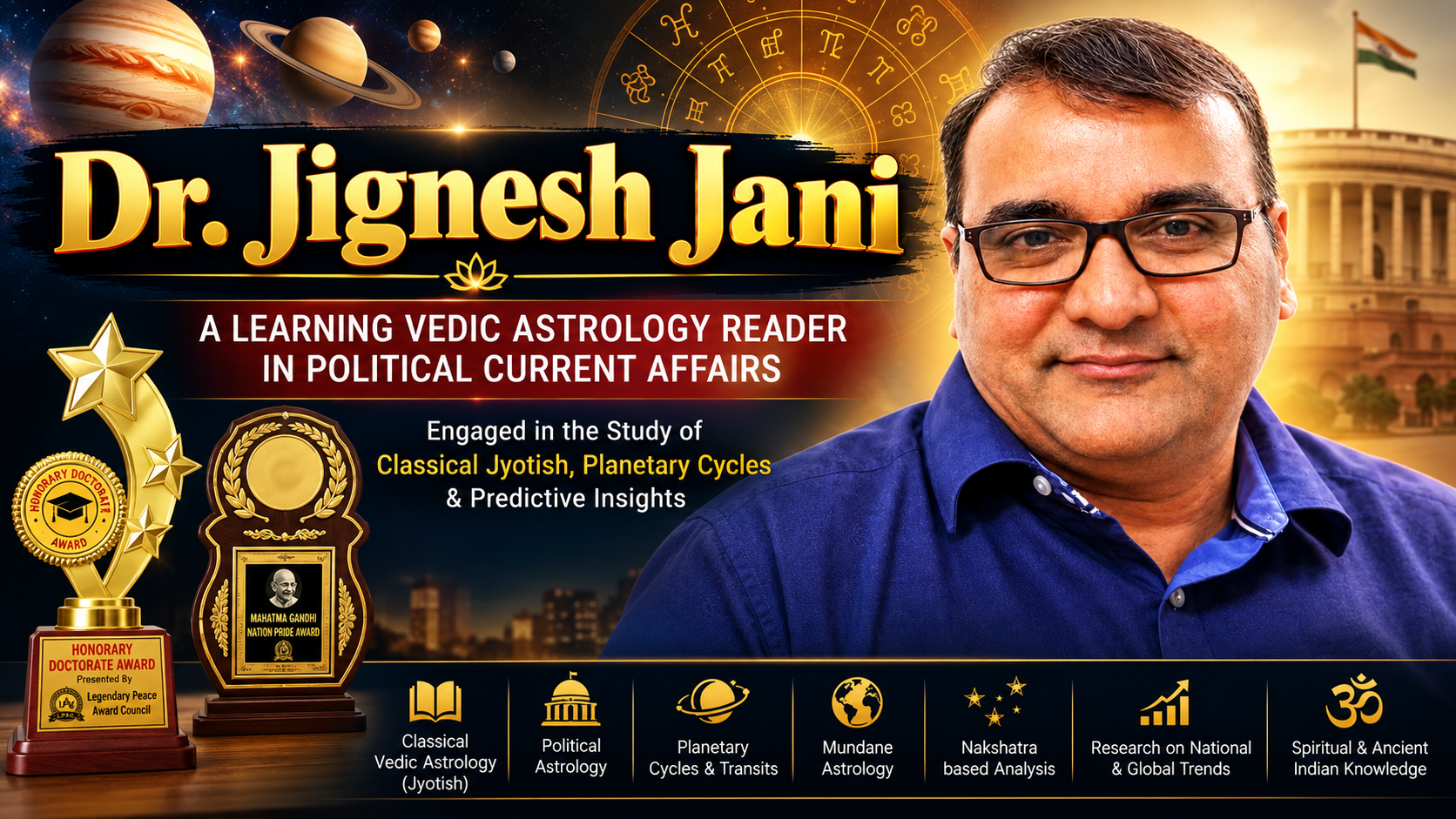

Ahmedabad | July 10, 2026: Amid growing public interest in global political developments and traditional astrology, Vedic astrology researcher Jignesh Jani has called for a balanced and responsible approach to interpreting planetary alignments. According to Jani, Vedic astrology can offer a symbolic perspective on collective trends, but it should never be confused with scientifically established methods of forecasting geopolitical events.
Jani explained that throughout history, practitioners of Jyotish have studied planetary cycles to understand broad social, political, and cultural patterns. These interpretations, he said, are intended to encourage reflection on long-term trends rather than predict the exact outcome of international disputes or political decisions.
Referring to the current planetary positions, Jani noted that many astrologers associate the Mars–Rahu conjunction, traditionally known as Angarak Yoga, with periods of heightened strategic activity, assertive leadership, and increased geopolitical tension. He also discussed the Saturn–Neptune alignment, which is often interpreted as symbolizing institutional transformation, ideological shifts, and changes in global governance.
At the same time, Jani highlighted the role of Jupiter in Vedic astrology. Traditionally associated with wisdom, ethics, justice, and diplomacy, Jupiter is regarded by many practitioners as a positive influence that supports peaceful negotiations, balanced leadership, and constructive international dialogue during uncertain periods.
Discussing current global affairs, Jani observed that the international landscape is shaped by economic challenges, technological competition, evolving alliances, and diplomatic engagement. He emphasized that while astrology may symbolically reflect these broader developments, the direction of world events is determined by the decisions of governments, policymakers, and international organizations.
“Astrology should be appreciated as part of our cultural and philosophical heritage,” Jani said. “It offers symbolic insights into collective cycles, but the future is shaped by human judgment, responsible leadership, and international cooperation—not by planetary positions alone.”
Jani concluded by encouraging readers to separate traditional astrological beliefs from evidence-based geopolitical analysis. He expressed hope that diplomacy, mutual respect, and peaceful dialogue will remain the guiding principles for resolving international challenges and building a more stable and cooperative global future.