
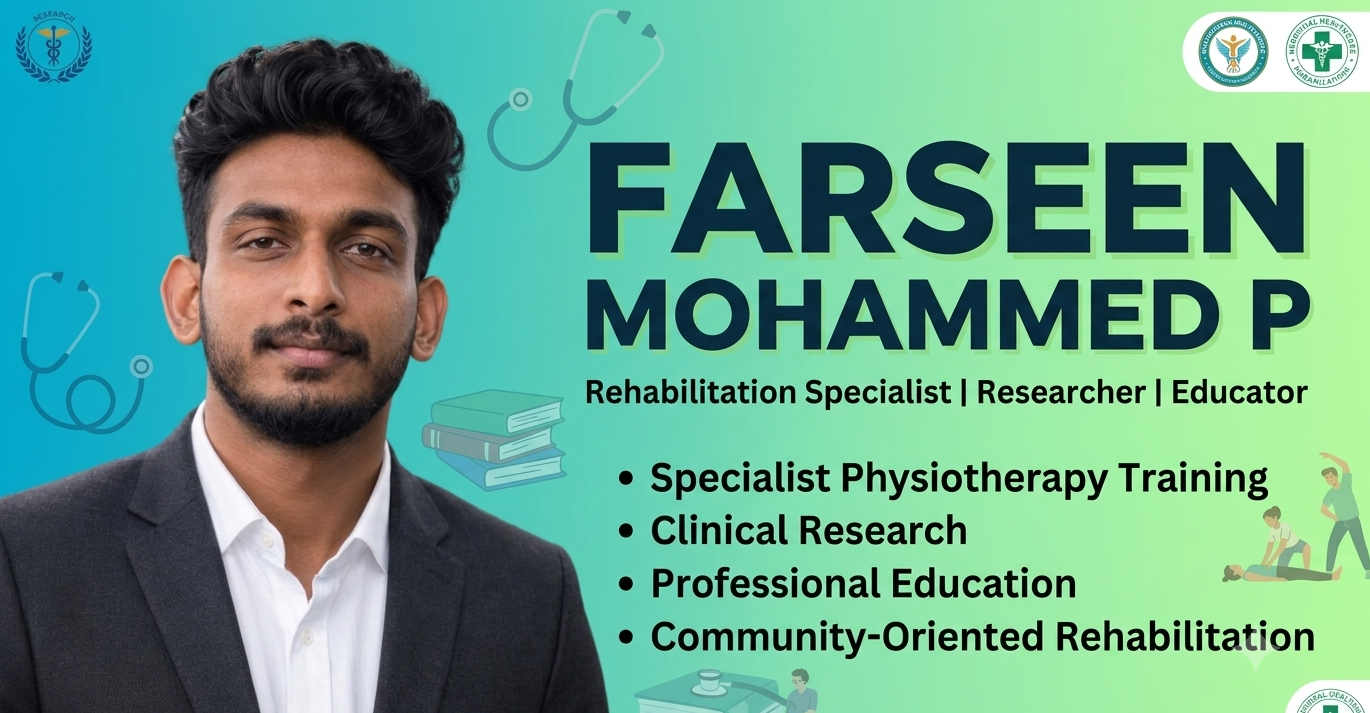

Mangaluru, Karnataka / Malappuram, Kerala: Research methodology has become an important part of modern healthcare education, particularly for professionals seeking to connect clinical practice with scientific evidence. For Farseen Mohammed P, training in systematic reviews and meta-analysis has become an important component of his development as a physiotherapist and clinical researcher.
With postgraduate specialization in neurosciences and research interests spanning neurorehabilitation, stroke rehabilitation, Parkinson’s disease and therapeutic exercise, Farseen has increasingly incorporated evidence-synthesis methods into his academic work.
Developing Research Methodology Skills
Farseen completed his Master of Physiotherapy in Neurosciences at Yenepoya Physiotherapy College, Yenepoya (Deemed to be University), Mangaluru.
During his postgraduate education, he developed an interest in clinical research, particularly in questions related to neurological rehabilitation and therapeutic exercise.
His academic work subsequently expanded into systematic reviews, scoping reviews and evidence synthesis.
Five-Day International-Level Workshop
An important step in his research-methodology development came in August 2026, when Farseen participated in a five-day hands-on workshop on Systematic Review and Meta-Analysis conducted by IIRA, Mumbai.
The workshop was held from 27 to 31 August 2026 and provided focused training in research methods used for evidence synthesis.
Hands-on training of this type can complement formal academic education by providing researchers with practical exposure to the processes involved in conducting literature-based research.
Why Systematic Reviews Matter
A systematic review uses a structured methodology to identify, assess and synthesize relevant research surrounding a defined question.
For physiotherapy and rehabilitation research, systematic reviews can help researchers examine evidence relating to therapeutic interventions, clinical outcomes and rehabilitation strategies.
Meta-analysis can, when appropriate, provide a statistical method for combining results from comparable studies.
Farseen’s interest in these methods is closely connected with his broader focus on evidence-based physiotherapy.
Application to Stroke Rehabilitation
One of Farseen’s important research interests in systematic review methodology is stroke rehabilitation.
His ongoing systematic review examines the effectiveness of eccentric strengthening interventions on functional outcomes in adults after stroke.
The topic builds on his postgraduate dissertation, which investigated:
“Effect of Eccentric Versus Concentric Strengthening on Functional Mobility in Subacute Stroke Patients: A Randomized Parallel-Group Comparative Study.”
His postgraduate study examined a specific clinical research question, while the systematic review takes a broader approach by examining relevant research evidence.
Presentation at SYNERGOS 2026
Farseen’s work in systematic review research was also presented at SYNERGOS 2026.
He presented “Effectiveness of Eccentric Strengthening Interventions in Stroke Rehabilitation: A Systematic Review.”
His presentation received the First Prize in the Postgraduate Oral Paper Presentation category.
The recognition represented an important milestone in his development as a researcher and scientific presenter.
Experience With Scoping Reviews
Farseen’s research methodology experience also includes scoping reviews.
In 2026, he contributed to the published paper “Timing of Dopaminergic Medication Relative to Physiotherapy Delivery in Adults with Parkinson’s Disease: A Scoping Review.”
The research was published in the International Journal of Drug Delivery Technology, with Farseen listed as the second author and corresponding author.
Scoping reviews can be used to map available literature around a topic and identify the range of research that has been conducted.
Research Beyond Neurological Rehabilitation
Farseen’s evidence-synthesis interests are not limited to stroke and Parkinson’s disease.
His ongoing research interests include a systematic review concerning exercise-based cardiac rehabilitation and cardiovascular autonomic and cerebral outcomes in adults with heart failure and stable coronary artery disease.
He is also interested in exercise interventions for adults with metabolic dysfunction-associated steatotic liver disease, including hepatic, metabolic, functional and muscle-strength outcomes.
These topics demonstrate the broader application of his research interests in exercise and rehabilitation.
Connecting Research Training With Clinical Knowledge
Farseen’s research-methodology development is supported by his clinical background.
During postgraduate clinical training at Yenepoya Medical College Hospital, Mangaluru, he gained exposure to neurological rehabilitation involving stroke, Parkinson’s disease, traumatic brain injury, Guillain–Barré syndrome and spinal cord disorders.
This clinical experience has provided a foundation for developing research questions related to rehabilitation interventions and functional outcomes.
Additional Research Training
The systematic review and meta-analysis workshop is part of a broader pattern of research-related professional education.
Farseen has also completed training related to Good Clinical Practice and health science research and publication.
His continuing professional development includes scientific presentations, research projects and academic conference participation.
Together, these activities have contributed to a research-oriented professional profile.
Evidence-Based Physiotherapy
Evidence-based physiotherapy requires practitioners to remain engaged with scientific literature and developments in rehabilitation research.
Farseen’s involvement in systematic reviews and scoping reviews reflects his interest in understanding the available evidence behind rehabilitation approaches.
His professional interests include evidence-based physiotherapy, clinical intervention research, therapeutic exercise and neurorehabilitation.
Scientific Communication
Research methodology and scientific communication are closely connected.
Farseen has presented his research at professional conferences, including Mangalore PhysioCon 2026 and SYNERGOS 2026.
His first-prize recognition at SYNERGOS demonstrates his experience communicating systematic review research to an academic audience.
His published Parkinson’s disease scoping review provides another example of his involvement in scientific research communication.
Continuing Development as a Clinical Researcher
Training in systematic review and meta-analysis represents one component of Farseen Mohammed P’s broader development as a clinical researcher.
His professional journey combines formal physiotherapy education, postgraduate specialization, clinical training, research projects, scientific presentations and continuing education.
The addition of research-methodology training strengthens this combination by providing further tools for examining evidence in rehabilitation sciences.
Looking Ahead
Farseen continues to develop research interests involving stroke rehabilitation, Parkinson’s disease, therapeutic exercise, cardiac rehabilitation and metabolic health.
His ongoing projects and continued professional education suggest that systematic review and evidence synthesis will remain important elements of his academic development.
As a physiotherapist working toward a research-oriented career, Farseen Mohammed P’s training in systematic review and meta-analysis provides another foundation for engaging with evidence-based rehabilitation research.